If you run a MySQL-backed application, this pattern is probably familiar:
- Dashboards repeatedly execute the same
GROUP BYqueries. - API endpoints keep requesting the same counts, sums, and rankings.
- Under write load, those queries become expensive.
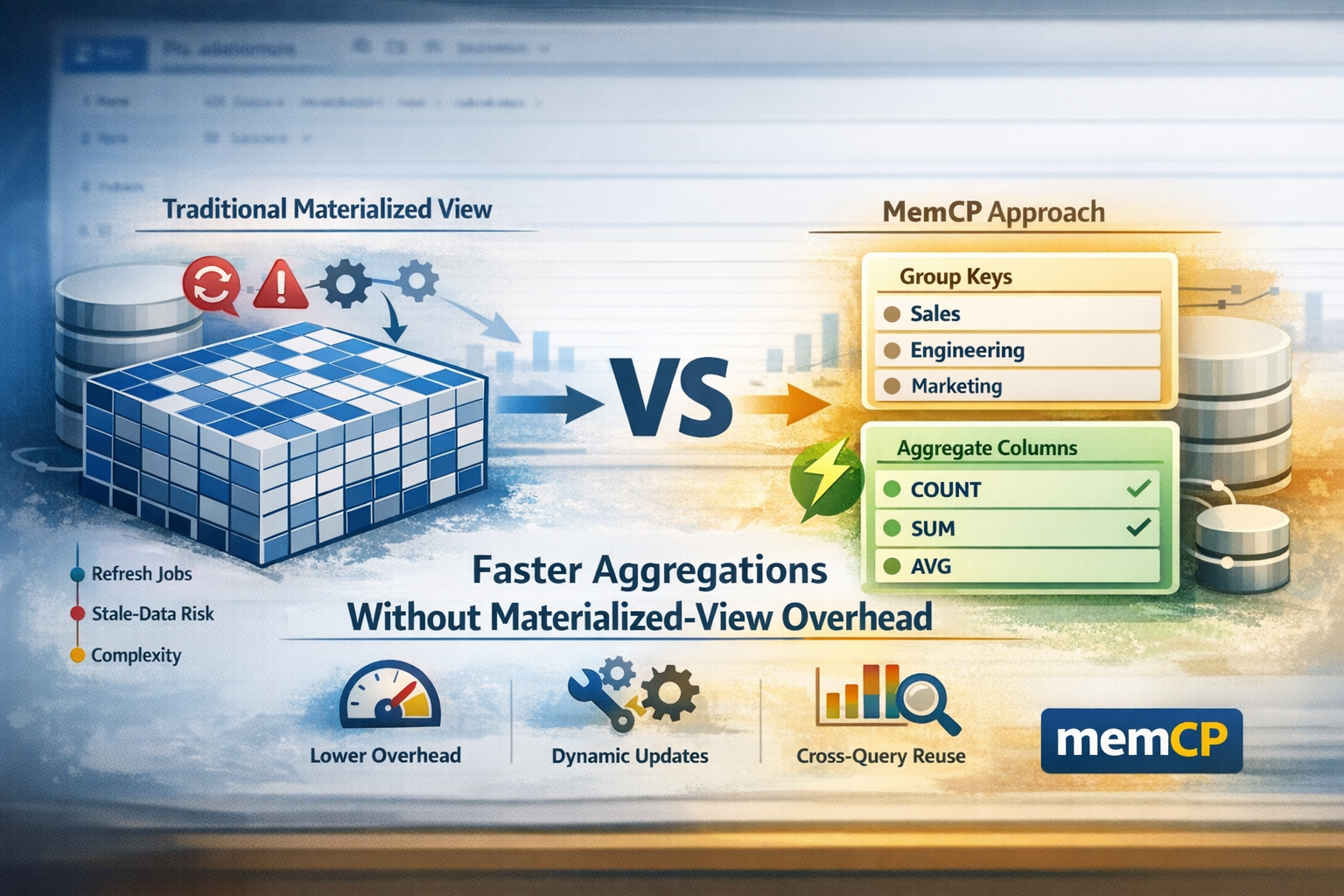
The usual workaround is a combination of caches, helper tables, or manually maintained materialized-view-like pipelines. It can work, but it adds operational complexity: refresh jobs, stale-data risk, and extra application logic.
MemCP takes a different path: it does not materialize full grouped result tables by default. Instead, it materializes only what is needed, at the aggregate-column level.
What Is Different?
Instead of storing one full cached result table per grouped query, MemCP separates:
- Group keys (
GROUP BYvalues) - Aggregate columns (
COUNT(*),SUM(...), and similar expressions)
This allows the engine to cache, invalidate, and recompute much more selectively.
For application teams, that means:
- no manual materialized-view management for common aggregation workloads
- less repeated compute for frequently requested grouped metrics
- more stable latency for dashboards and reporting APIs
A Typical MySQL Scenario
SELECT department, SUM(salary), COUNT(*)
FROM employees
GROUP BY department;
In many production systems, this query (or close variants) is executed over and over, even though only a small subset of rows changed since the previous run.
MemCP keeps a compact internal key domain (for example, one row per department) and attaches aggregate columns to that domain. If a query only needs COUNT(*), the engine does not need to recompute unrelated aggregates just to serve that request.
Why This Matters in Real Apps
1) Lower overhead than full materialization
Traditional materialized-view workflows are often all-or-nothing: rebuild large result sets or manage refresh logic manually.
MemCP can work per aggregate column, which reduces unnecessary compute and memory pressure in common analytics paths.
2) Fine-grained maintenance
Most writes affect only a small number of groups.
MemCP updates or invalidates only affected groups and affected aggregate columns. For additive metrics like SUM and COUNT, maintenance can be especially cheap.
3) Cross-query reuse
If multiple endpoints rely on the same grouped metrics, MemCP can reuse those computed aggregates internally instead of recomputing from scratch for every query.
This is useful for:
- dashboard tiles
- KPI endpoints
- repeated reporting queries
4) Less application-side infrastructure
You do not need to build and maintain as much custom cache/refresh plumbing in your app code just to keep grouped queries fast.
What MySQL Users Gain
Moving from MySQL to MemCP keeps SQL workflows familiar, but changes how aggregation is executed internally:
- repeated
GROUP BYqueries become cheaper - mixed read/write workloads are easier to keep responsive
- operational burden around aggregation caching is reduced
This is most valuable when your team is already spending time optimizing repeated analytical queries in application code.
Best Fit Workloads
- SaaS products with many metric views
- admin backends with heavily used overview pages
- product analytics with recurring grouped summaries
- systems that serve reports while ingesting ongoing writes
Bottom Line
For teams coming from MySQL, the core advantage is simple:
MemCP treats aggregations as reusable, independently maintained aggregate columns over group keys, rather than as disposable full-query recomputation or manually maintained full materialized views.
That improves performance where many apps struggle most: frequent GROUP BY queries under concurrent write load.
Source code: https://github.com/launix-de/memcp
 English
  German
Comments are closed