MemCP is a high-performance, in-memory, column-oriented database.
Columnar storage means every column is stored as a contiguous array, which opens up compression opportunities that row-based databases cannot exploit.
One of the most impactful cases is enum-like columns: booleans, nullable flags, status codes, categories — any column where a small set of values repeats millions of times.
This post compares three encoding strategies for such columns, using measurements from our microbenchmark suite running on an AMD Ryzen 9 7900X3D.
The Three Encodings
Byte Encoding (Traditional Databases)
The simplest approach: store one byte per value.
A MySQL TINYINT or BOOL column uses exactly this.
- Storage: 8 bits/element, regardless of distribution
- Access: O(1) direct array indexing
- Waste: For a boolean column that is 99%
false, 7.92 of those 8 bits carry zero information
For 60,000 booleans: 60,000 bytes.
PFOR Bit-Packing (MemCP old)
Patched Frame-Of-Reference packs each value into the minimum number of bits.
For k distinct values, that is ceil(log2(k)) bits per element.
- Storage: ceil(log2(k)) bits/element
- Access: O(1) with bit-shift arithmetic
- Improvement: A 2-value boolean column drops from 8 to 1 bit/element — an 8x improvement
For 60,000 booleans: 7,500 bytes (1 bit each).
But PFOR is blind to the actual distribution.
A column that is 99% false and 1% true still uses 1 bit per element, even though information theory says the optimal cost is only 0.081 bits/element.
PFOR wastes 12x the theoretical minimum.
Bitcompress: k-ary rANS (MemCP new)
MemCP’s new encoding uses rANS (range Asymmetric Numeral Systems), an entropy coder that approaches Shannon’s theoretical limit.
Instead of assigning fixed-width bit slots, rANS encodes each symbol with a cost proportional to its information content: -log2(probability) bits.
- Storage: approaches -sum(p_i * log2(p_i)) bits/element (Shannon entropy)
- Access: O(1) sequential, O(log n) random via 2-level jump index
- Key advantage: the rarer a value is, the more bits it gets; the more common, the fewer — automatically
For 60,000 booleans (99% false):
| Encoding | Size | bits/elem | vs Shannon |
|---|---|---|---|
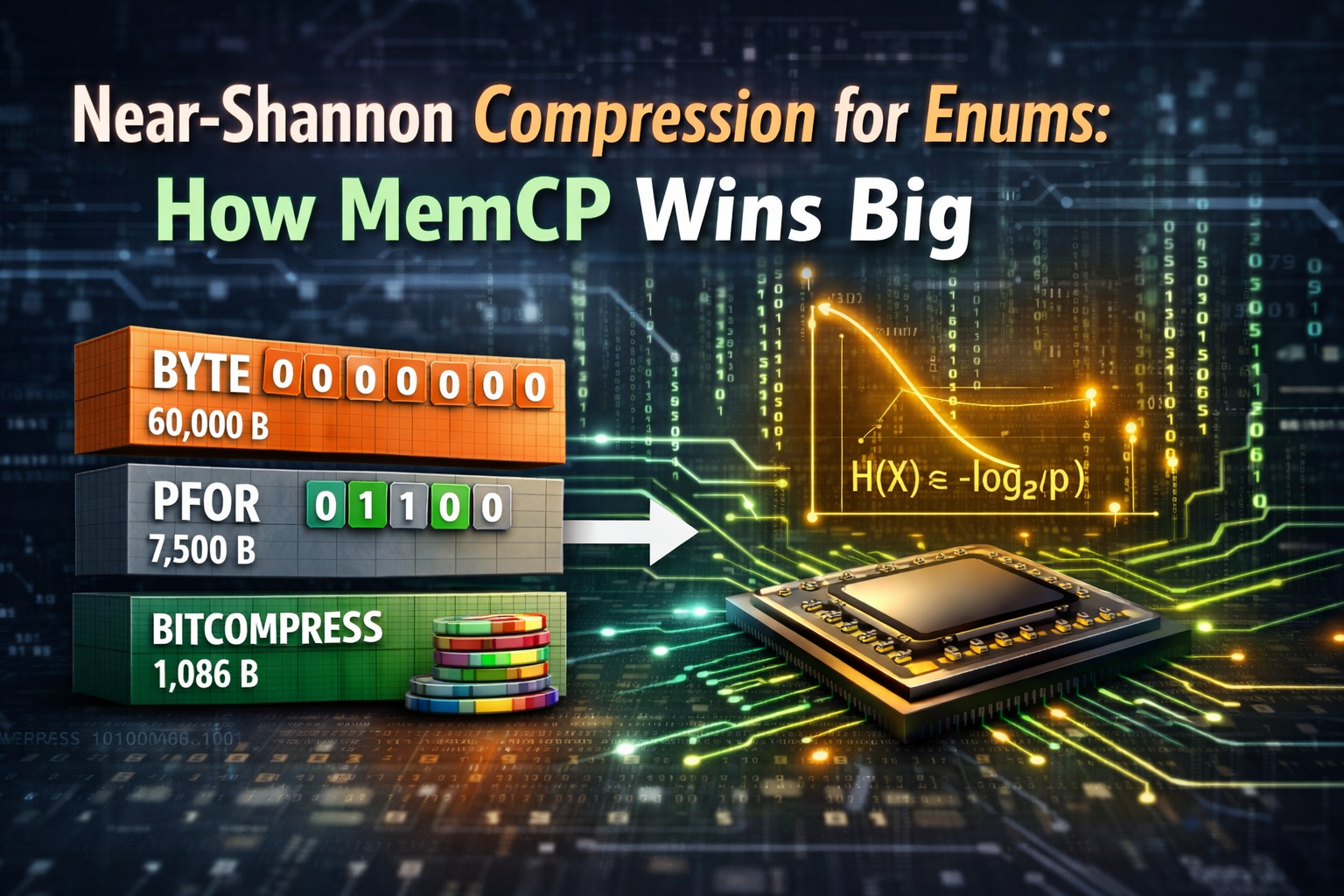
| Byte | 60,000 B | 8.000 | 99x |
| PFOR | 7,500 B | 1.000 | 12x |
| Bitcompress | 1,086 B | 0.088 | 1.09x |
That is 55x smaller than PFOR and within 9% of the theoretical limit.
How Bitcompress Works
The codec operates on 8-bit precision.
The 256-slot interval [0, 256) is partitioned proportionally to each symbol’s probability.
A 99/1 boolean gets slots [0, 253) for false and [253, 256) for true.
Encoding packs symbols into a 64-bit buffer via modular arithmetic:
bufferx, rest = fastDivMod(buffer, width, invWidth)
buffer = (bufferx << 8) + lo + rest
Division is replaced by multiplication using a precomputed inverse (Barrett reduction via bits.Mul64), making the hot path division-free.
Decoding extracts the bottom 8 bits to identify the symbol, then reverses the arithmetic:
slice = buffer & 0xFF
symbol = lookup(slice)
buffer = (buffer >> 8) * width + slice - lo
When the buffer would overflow, it is flushed as a 64-bit chunk.
A 2-level jump index enables O(log n) random access into the chunk stream:
- L2 (uint16): per-chunk cumulative element count, relative to L1 base
- L1 (uint32): absolute cumulative count every K chunks
This supports billions of elements while using only 2 bytes of index per chunk.
A sequential decode cache makes forward iteration O(1) per element.
Measured Performance
All benchmarks on AMD Ryzen 9 7900X3D, Go 1.24, -benchtime=2s.
Access Latency (60k elements, boolean 99/1 skew)
| Access Pattern | Latency |
|---|---|
| Sequential scan | 4 ns/elem |
| Sparse scan (50% density) | 9 ns/elem |
| Sparse scan (10% density) | 16 ns/elem |
| Random access | 674 ns/elem |
Sequential and sparse access — the dominant patterns in analytical queries (WHERE filters, aggregations) — are extremely fast.
Random access is slower because it requires binary search plus decoding within the target chunk, but this pattern is rare in columnar analytics.
Scaling: 1 Million Elements
The 2-level jump index scales cleanly.
For 1M booleans (99% false, 1% true):
| Encoding | Total Size | bits/elem |
|---|---|---|
| Byte | 1,000,000 B | 8.000 |
| PFOR | 125,000 B | 1.000 |
| Bitcompress | 14,270 B | 0.088 |
1 million booleans in 14 KB. That is 70x smaller than PFOR.
Sequential scan still runs at 4 ns/element — the same speed as at 60K.
The jump index adds only 2,934 bytes (1,379 L2 entries + 44 L1 entries).
Import/Export Throughput
| Operation | 5k elements |
|---|---|
| Import (encode) | 45 us |
| Export (decode) | 22 us |
Encoding is compute-bound (one multiply per element); decoding is faster because it avoids division entirely.
Where Bitcompress Wins Big
The advantage of entropy coding grows with skew.
Here is the compression ratio across different distributions:
| Distribution | Byte | PFOR | Bitcompress | Shannon |
|---|---|---|---|---|
| Boolean 50/50 (uniform) | 8.000 | 1.000 | 1.094 | 1.000 |
| Boolean 95/5 | 8.000 | 1.000 | 0.320 | 0.286 |
| Boolean 99/1 | 8.000 | 1.000 | 0.088 | 0.081 |
| 4-way 80/15/4/1 | 8.000 | 2.000 | 1.011 | 0.920 |
| 5-way skewed | 8.000 | 3.000 | 1.994 | 1.817 |
The pattern: the more skewed the distribution, the bigger the gap between PFOR and Bitcompress.
For the uniform case (50/50 boolean), Bitcompress is slightly worse than PFOR due to chunk overhead.
But real-world data is almost never uniform.
Nullable columns are overwhelmingly non-NULL.
Status columns cluster around a few common states.
Boolean flags are usually one value.
These are exactly the distributions where Bitcompress delivers 10-100x compression over PFOR.
The Sweet Spot: Low-Entropy Enums in Large Databases
Consider a production database with 10 million rows and a is_deleted boolean column that is 99.5% false.
| Encoding | Column Size |
|---|---|
| Byte (MySQL) | 10 MB |
| PFOR (MemCP old) | 1.25 MB |
| Bitcompress (MemCP new) | ~70 KB |
At 70 KB, the entire column fits in L1 cache.
At 1.25 MB, it spills to L2.
At 10 MB, it spills to L3 or main memory.
For an in-memory database like MemCP, this is not just a storage win — it is a speed win.
Less memory means fewer cache misses, which means faster scans, joins, and aggregations.
And because sequential decoding runs at 4 ns/element, the decompression cost is negligible compared to the cache-miss latency it avoids.
Summary
| Byte | PFOR | Bitcompress | |
|---|---|---|---|
| Bits/elem (99/1 bool) | 8.000 | 1.000 | 0.088 |
| Compression vs Shannon | 99x | 12x | 1.09x |
| Sequential access | 1 ns | 2 ns | 4 ns |
| Supports skewed data | No benefit | No benefit | Massive benefit |
| Max symbols | 256 | any | 256 |
Bitcompress trades a small constant overhead on sequential access (4 ns vs 1-2 ns for uncompressed) for compression ratios that approach the theoretical limit.
For the skewed distributions that dominate real-world enum columns, this trade-off is overwhelmingly positive: smaller working sets, fewer cache misses, and faster end-to-end query execution.
The implementation is open source as part of MemCP.
 English
  German
Comments are closed